What Is HPLC? Understanding High-Performance Liquid Chromatography
HPLC separates components within a liquid sample so researchers can examine them individually. Learn how the technique works, what a chromatogram shows, and why understanding the analytical method matters.
By The Vault Journal Editorial Team · Published September 15, 2026 · 6–8 min read
Published by The Vault Journal — A Bio Vault Labs Publication
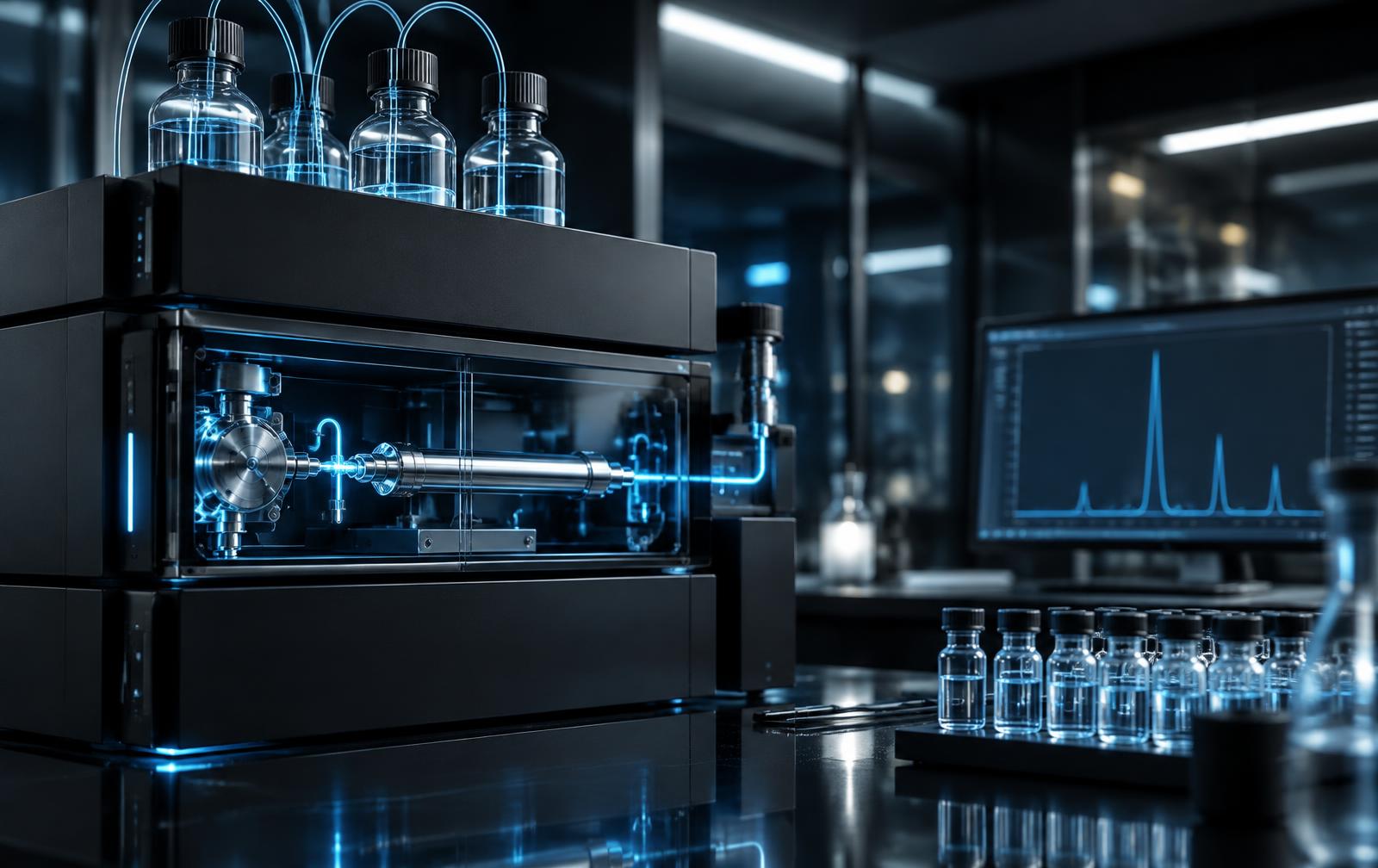
Walk into an analytical laboratory and there's a good chance you'll encounter three letters repeatedly: HPLC.
HPLC stands for high-performance liquid chromatography. It is a form of liquid chromatography used to separate components within a mixture so they can be detected and analyzed.
The principle behind chromatography is straightforward: components of a mixture are distributed between a stationary phase and a mobile phase moving in a defined direction.[1] Because different components interact with these phases differently, they can travel through the chromatographic system at different rates.
Modern HPLC combines this separation principle with precisely controlled pumps, columns, sample introduction systems, and detectors to produce analytical data.
But understanding HPLC requires more than looking at a chromatogram or a reported percentage.
The analytical method—and the question that method was designed to answer—matters just as much.
How Does HPLC Work?
An HPLC analysis begins with a sample introduced into a flowing liquid known as the mobile phase.
The mobile phase carries the sample through a column containing the stationary phase.
Different components of the sample interact differently with the chromatographic system. Some move through relatively quickly, while others are retained for longer periods.
These differences allow components that entered the instrument together to become separated before reaching the detector.
A typical HPLC system contains several major components:
- Mobile phase — The liquid used to transport the sample through the system.
- Pump — Moves the mobile phase through the instrument at a controlled flow.
- Injector or autosampler — Introduces a measured sample into the mobile phase.
- Column — Contains the stationary phase where chromatographic separation occurs.
- Detector — Measures a response as separated components leave the column.
- Data system — Records and processes the detector signal to produce the chromatogram.
Together, these components turn a liquid sample into a measurable separation.
The Column: Where Separation Happens
The column is central to an HPLC experiment.
Inside it, sample components encounter the stationary phase. Their differing interactions with the stationary and mobile phases influence how quickly they travel through the column.
Chromatographic separations can rely on different mechanisms. Depending on the technique, separation may involve differences in partitioning, adsorption, ionic interactions, or molecular size.[1,2]
That is why saying a material was simply “tested by HPLC” does not fully describe the analysis.
The column chemistry, mobile phase, flow conditions, detector, sample preparation, temperature, and other method parameters can affect the resulting separation.
Two HPLC methods can therefore analyze similar samples while being designed to answer different analytical questions.
That distinction also shapes how reported results should be read — see What Does “99% Purity” Actually Mean?.
From Separation to Chromatogram
As separated components leave the column, the detector records a response.
The resulting plot is called a chromatogram.
A chromatogram commonly displays detector response on one axis and time on the other. Individual detector responses may appear as peaks.
Two concepts are particularly useful when learning how to interpret chromatographic data.
Retention Time
Different components may require different amounts of time to travel through the chromatographic system.
This behavior is described using retention measurements.
Under controlled experimental conditions, retention behavior can provide useful analytical information.
However, retention behavior should not automatically be treated as complete proof of a compound's identity. Interpretation depends on the method and the other analytical evidence available.
Peak Area
The detector response associated with a chromatographic peak can also provide quantitative information.
With an appropriately developed method and suitable calibration, the detector response can be related to the amount or concentration of an analyte.
That does not mean every peak should automatically be interpreted as a direct percentage of a sample.
Detector characteristics, calibration, standards, sample preparation, integration methods, and the analytical procedure itself all influence how quantitative results should be interpreted.
What Can HPLC Tell Researchers?
HPLC is not a single test with a single purpose.
It is an analytical platform that can be adapted to different research questions.
Depending on the method, researchers may use liquid chromatography to separate sample components, measure analytes, examine impurities, compare samples, or prepare components for additional forms of detection and analysis.
The key phrase is depending on the method.
An analytical result has meaning because a procedure has been designed to measure something specific.
Researchers therefore need context surrounding the result:
- What analytical procedure was used?
- What detector was used?
- How was the sample prepared?
- What standards or reference materials were used?
- What chromatographic conditions were applied?
- What was the method intended to measure?
- Was the procedure shown to be suitable for that purpose?
Without this context, a single chromatographic number can reveal much less than it initially appears to.
What HPLC Cannot Tell You by Itself
One of the most important lessons in analytical chemistry is that a chromatogram does not answer every question about a sample.
HPLC separates components and allows them to be detected according to a particular analytical procedure.
But a chromatographic peak alone should not automatically be interpreted as definitive proof of molecular identity.
When greater structural information is required, chromatography can be combined with other analytical technologies.
One prominent example is liquid chromatography–mass spectrometry (LC–MS). In LC–MS, liquid chromatography separates components before they are detected using a mass spectrometer.[3]
Likewise, a reported value such as “99%” has limited meaning without knowing what the percentage represents and how it was determined.
Was it based on chromatographic peak area?
Was a quantitative assay performed?
What detector was used?
Were reference standards involved?
What method and calculations produced the result?
The surrounding analytical context is essential.
Why Analytical Method Validation Matters
An instrument can produce data.
That does not automatically mean the analytical procedure is suitable for its intended purpose.
Method validation is used to establish evidence that an analytical procedure performs appropriately for the question it is designed to answer.
FDA's current ICH Q2(R2) guidance provides a general framework for analytical procedure validation, while ICH Q14 describes scientific approaches to analytical procedure development.[4,5]
Depending on the analytical procedure and its intended use, scientists may evaluate characteristics such as selectivity or specificity, accuracy, precision, range, and robustness.
The exact characteristics that matter depend on what the procedure is intended to accomplish.
This leads to a useful way of thinking about analytical science:
Define the analytical question → develop an appropriate procedure → evaluate its performance → analyze the sample → interpret the resulting data in context.
The instrument is only one part of that process.
HPLC and Certificates of Analysis
HPLC frequently appears on analytical documentation, including Certificates of Analysis.
Seeing HPLC on a report tells you something about the analytical technique that was used—but it does not automatically tell you everything about the material being evaluated.
A careful reader should ask:
- What was being measured?
- What analytical procedure was used?
- What does the reported value represent?
- What detector and chromatographic conditions were used?
- Were appropriate standards or reference materials involved?
- Is the result traceable to the sample or batch described by the document?
Understanding these questions is far more informative than simply searching a report for a high percentage.
The Vault Journal will explore this subject further in our guide to reading a Certificate of Analysis.
The Takeaway
HPLC is powerful because it allows scientists to separate components of complex mixtures and transform those separations into measurable analytical information.
But HPLC is not a machine that produces context-free answers.
A chromatogram must be interpreted alongside the analytical procedure, detector, reference materials, experimental conditions, validation work, and the scientific question being investigated.
So the next time you see HPLC on an analytical report, don't stop at the acronym or the largest percentage on the page.
Ask a better question:
What was actually measured—and how?
That is where understanding the data begins.
Reference
Key Terms
- HPLC
- High-performance liquid chromatography, an instrumental form of liquid chromatography used to separate and analyze components of mixtures.
- Mobile Phase
- The phase that moves through the chromatographic system and carries sample components.
- Stationary Phase
- The phase that remains fixed within the chromatographic system and participates in separation.
- Chromatogram
- A representation of the detector response generated during a chromatographic separation.
- Retention Time
- A measurement associated with how long a sample component takes to pass through the chromatographic system under specified conditions.
- Detector
- The component of the instrument that generates a measurable response as separated substances leave the column.
- LC–MS
- Liquid chromatography–mass spectrometry, in which liquid chromatography separates components before mass-spectrometric detection.
References
- [1] International Union of Pure and Applied Chemistry (IUPAC). Compendium of Chemical Terminology (Gold Book): Liquid Chromatography.
- [2] National Institute of Standards and Technology (NIST). Lane C. Sander. Liquid Chromatography: Introduction and Instrumentation.
- [3] International Union of Pure and Applied Chemistry (IUPAC). Compendium of Chemical Terminology (Gold Book): Liquid Chromatography–Mass Spectrometry.
- [4] U.S. Food and Drug Administration / ICH. Q2(R2): Validation of Analytical Procedures. Final Guidance, March 2024.
- [5] U.S. Food and Drug Administration / ICH. Q14: Analytical Procedure Development. Final Guidance, March 2024.
This article is for educational and informational purposes only. It does not provide medical advice, diagnosis, or treatment recommendations.
Back to the journalContinue Reading
Related Stories
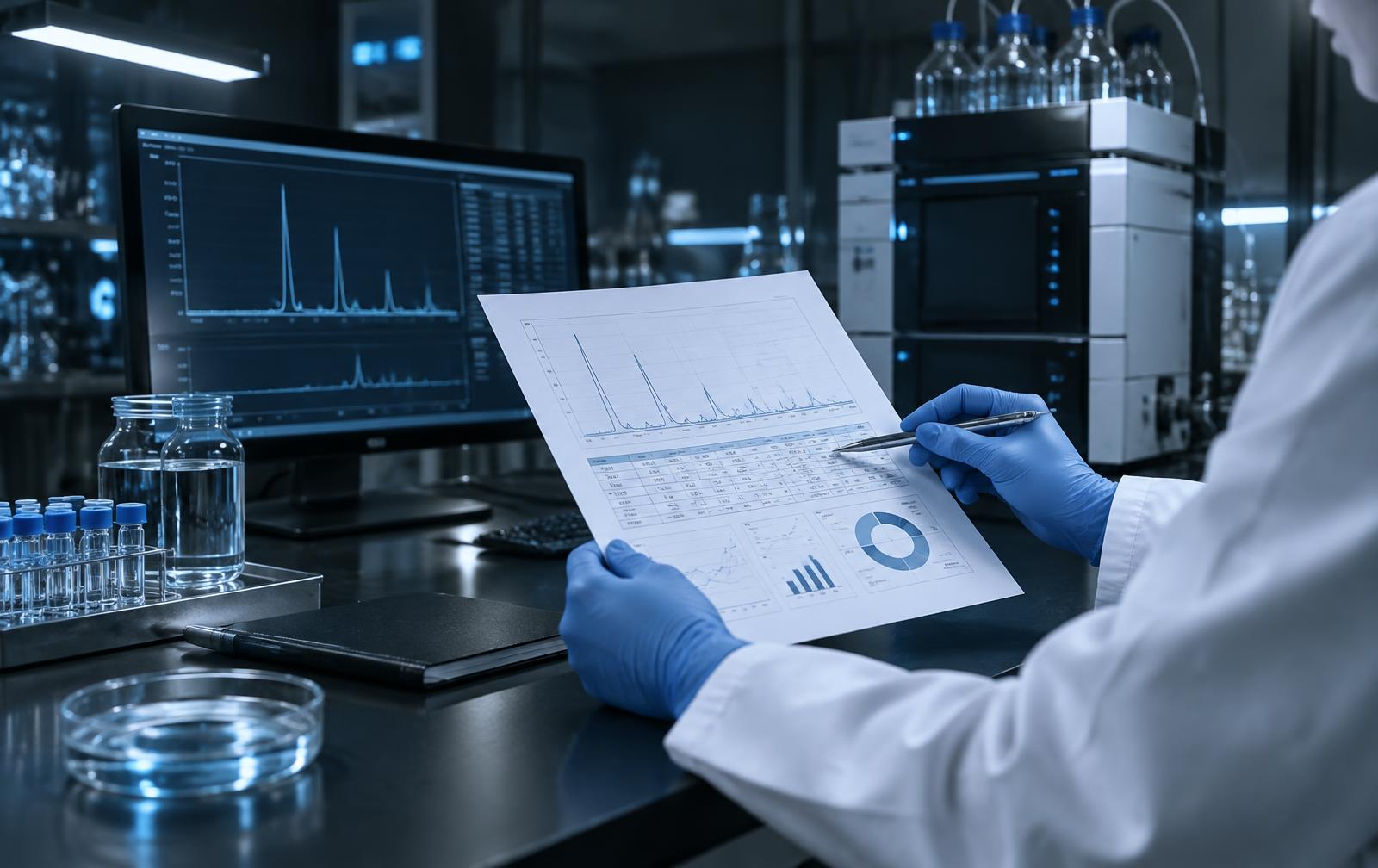
Lab Science
How to Read a Certificate of Analysis
A Certificate of Analysis contains more than a headline percentage. Learn how to evaluate batch information, analytical methods, specifications, results, reference standards, and traceability.
By The Vault Journal Editorial Team · 7–9 min read
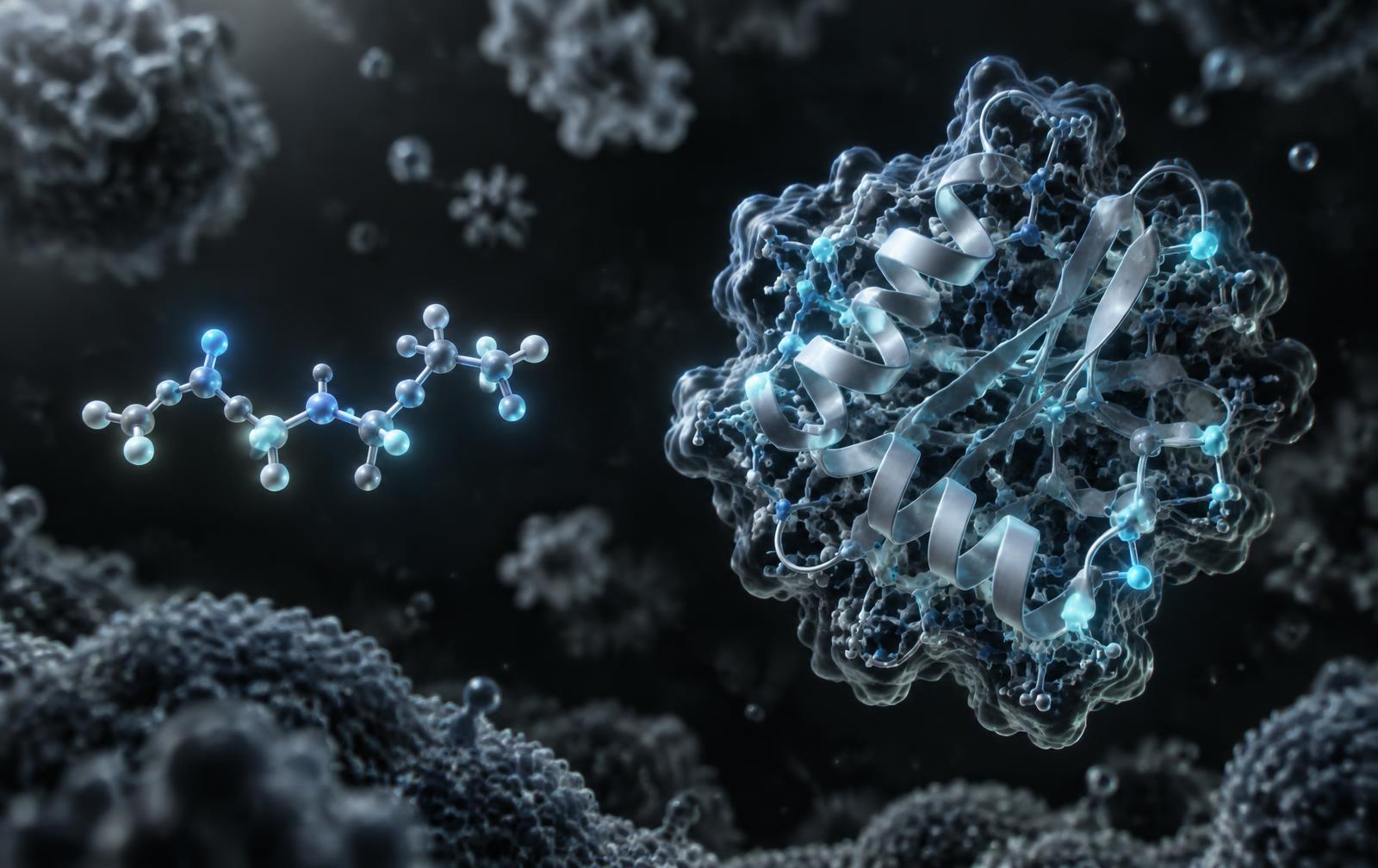
Molecular Biology
Peptides vs. Proteins: What's the Difference?
Peptides and proteins are both built from amino acids, but they aren't interchangeable terms. Learn how chain length, sequence, folding, structure, and biological context distinguish them.
By The Vault Journal Editorial Team · 6–8 min read
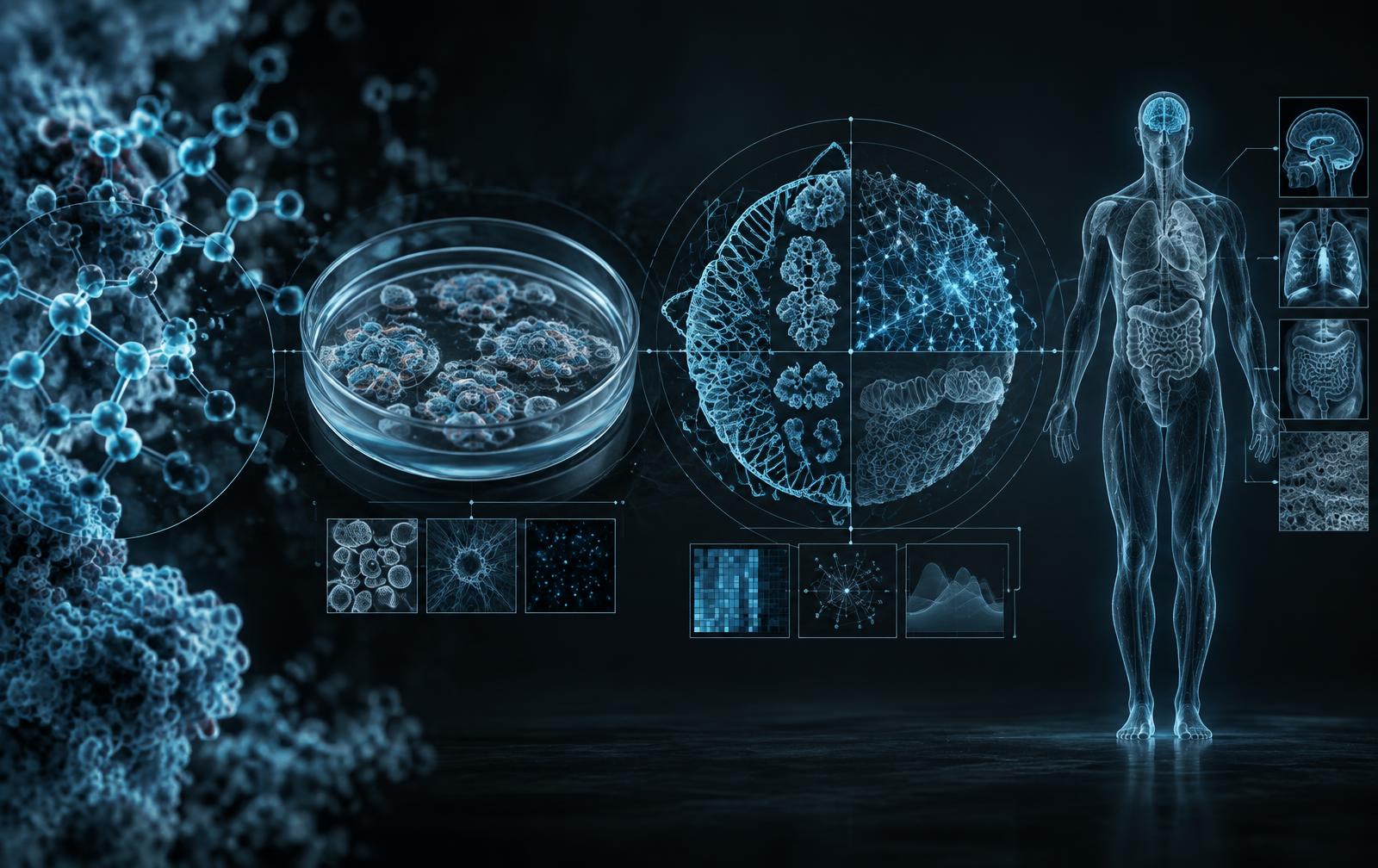
Research Guides
From a Petri Dish to a Person: Why Different Levels of Evidence Matter
A result in cells can be scientifically important without telling us exactly what will happen in a person. Understanding the different levels of research helps explain why.
By The Vault Journal Editorial Team · 8–10 min read