Peptides vs. Proteins: What's the Difference?
Peptides and proteins are both built from amino acids, but they aren't interchangeable terms. Learn how chain length, sequence, folding, structure, and biological context distinguish them.
By The Vault Journal Editorial Team · Published September 17, 2026 · 6–8 min read
Published by The Vault Journal — A Bio Vault Labs Publication
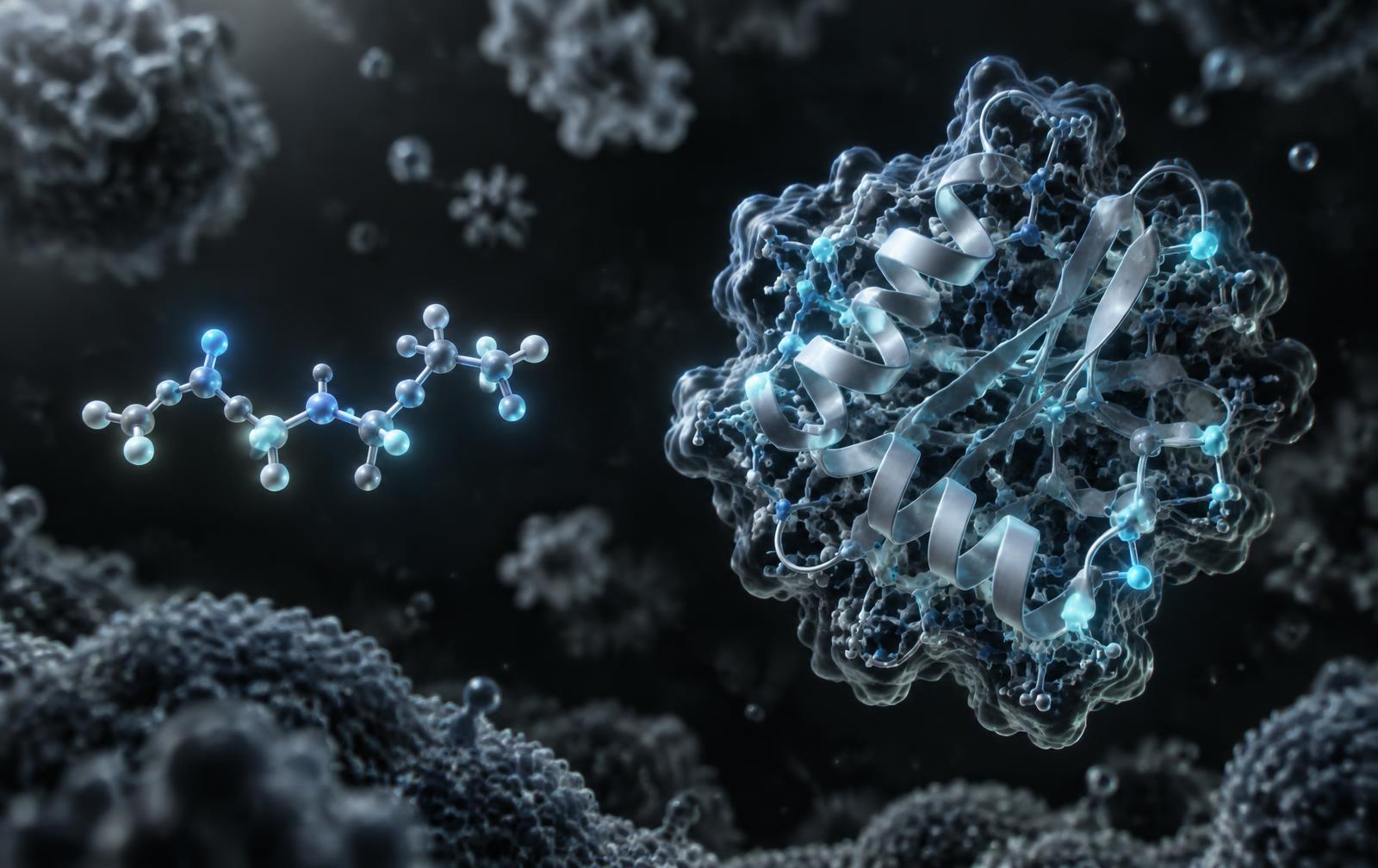
Peptides and proteins are often discussed as though they belong to completely separate categories.
Chemically, however, they are closely related.
Both are built from amino acids connected by peptide bonds. In fact, proteins are composed of one or more amino-acid chains known as polypeptides.[1]
So where does a peptide end and a protein begin?
The answer is more nuanced than simply counting amino acids.
Chain length is useful, but structure, folding, biological function, and scientific convention also influence how these molecules are described.
Understanding that relationship starts with their shared building blocks.
Start With Amino Acids
Amino acids are the fundamental units used to construct peptides and proteins.
Common protein-forming amino acids share a basic chemical framework but differ in their side chains, often called R groups. These side chains give different amino acids distinct chemical properties.
When amino acids connect, the carboxyl group associated with one residue becomes linked to the amino group associated with another through a peptide bond.
Repeating this process creates an amino-acid chain.
A very short chain may be described as a peptide.
A longer chain may be called a polypeptide.
And one or more appropriately organized and folded polypeptide chains can form a protein.[1,2]
This means peptides and proteins share the same fundamental chemical architecture.
What Is a Peptide?
A peptide is a molecule composed of amino-acid residues connected by peptide bonds.
Peptides can exist as linear, branched, or cyclic structures, although linear peptide chains are a common introductory model.[3]
Terms can become more specific depending on chain length.
For example:
- Dipeptide — two amino-acid residues.
- Tripeptide — three amino-acid residues.
- Oligopeptide — a relatively short chain of amino-acid residues.
- Polypeptide — a longer amino-acid chain.
The exact numerical boundaries used for these terms are not completely universal across every scientific source.
That is important.
You may encounter simplified explanations claiming that every chain below one exact number is a peptide and everything above it is a protein.
Biochemistry is not always that tidy.
Length is useful for classification, but it is not the only meaningful distinction.
Many peptides also act as signaling molecules in ordinary human physiology, which is where this chemistry meets everyday experience — see Why Does Recovery Feel Different as You Get Older?
What Is a Protein?
Proteins are biological macromolecules composed of one or more polypeptide chains with specific amino-acid sequences.
According to the National Human Genome Research Institute, proteins consist of one or more long, folded amino-acid chains, with their sequences ultimately encoded by genes.[2]
The word folded is especially important.
A protein is not simply a long molecular string.
Its amino-acid sequence influences how the chain interacts with itself and its environment, allowing many proteins to adopt characteristic three-dimensional structures.
Those structures are closely connected to biological function.
Proteins can participate in an enormous range of cellular processes, including catalysis, structural support, transport, signaling, molecular recognition, and regulation.[2,4]
The Four Levels of Protein Structure
Protein structure is commonly described at several organizational levels.
Primary Structure
The primary structure is the linear sequence of amino-acid residues in a polypeptide chain.
The order matters.
Changing the sequence can change how a chain behaves, folds, or functions.
Secondary Structure
Sections of the polypeptide backbone can form recurring local structures.
Two familiar examples are:
- Alpha helices
- Beta sheets
Hydrogen Bonding in Secondary Structure
These structures are stabilized largely through hydrogen bonding involving the peptide backbone.[4]
Tertiary Structure
The tertiary structure describes the overall three-dimensional arrangement of a single polypeptide chain.
Interactions among amino-acid side chains and the surrounding environment contribute to this folding.
Quaternary Structure
Some proteins consist of multiple polypeptide chains, often called subunits.
The organization and interaction of those subunits constitute quaternary structure.[4]
Not every protein requires all four structural levels, but the framework helps illustrate why protein identity involves more than chain length.
So Is the Difference Just Size?
No.
Peptides are generally discussed as shorter amino-acid chains, while proteins are typically larger and structurally more complex.
But there is no single universal amino-acid count that perfectly separates every peptide from every protein in every context.
Different references use somewhat different conventions.
For example, NCBI's Medical Subject Headings describes peptides broadly as amino acids joined by peptide bonds and distinguishes oligopeptides and polypeptides using approximate rather than absolute boundaries.[3]
Other educational sources may use different numerical conventions.
This is why statements such as:
- “Anything under exactly 50 amino acids is always a peptide.”
should be treated as simplified rules of thumb rather than universal laws of chemistry.
A better distinction considers several characteristics together:
- Chain length
- Structural organization
- Folding
- Biological context
- Scientific convention
Sequence Matters
Imagine two amino-acid chains containing exactly the same number and types of amino acids but arranged in different orders.
They are not necessarily equivalent molecules.
The sequence of amino acids influences the chemical behavior of the chain and, for proteins, strongly influences how the molecule folds into its three-dimensional structure.[1,4]
This relationship can be summarized as:
- Amino-acid sequence → molecular interactions → structure → function
That is one reason simply knowing the number of amino acids in a molecule tells you relatively little about what it actually does.
Structure Matters
Length alone also cannot describe the complete architecture of peptides and proteins.
Amino-acid chains can interact with themselves, other molecular chains, water, membranes, ions, and other molecules.
For proteins, these interactions can generate highly organized three-dimensional structures.
Protein folding can create pockets, surfaces, channels, binding regions, and other structural features that allow proteins to interact selectively with their molecular environment.
Enzymes, receptors, transport proteins, antibodies, and structural proteins all demonstrate how extensively biological function can depend on molecular structure.
Function Matters Too
Peptides and proteins can both participate in biological signaling and molecular recognition.
Their functions are not determined simply by whether scientists call them a “peptide” or “protein.”
And even when a signaling molecule is known to act at a specific receptor, that is only the first step in a longer biological sequence — a point examined in Why Receptor Activation Doesn’t Tell Us the Whole Story.
Instead, function emerges from properties such as:
- Amino-acid sequence
- Three-dimensional structure
- Chemical modifications
- Molecular interactions
- Cellular location
- Concentration
- Biological environment
This is another reason the peptide-versus-protein distinction should not be interpreted as meaning that one category is biologically important while the other is not.
Both can participate in highly specific molecular processes.
What About Polypeptides?
The term polypeptide helps connect the two concepts.
A polypeptide is an amino-acid chain joined by peptide bonds.
Proteins are composed of one or more polypeptide chains, but the terms *polypeptide* and *protein* are not always perfectly interchangeable.
“Polypeptide” emphasizes the molecular chain itself.
“Protein” often refers to the biologically organized molecule formed by one or more such chains.
This distinction becomes especially useful when discussing protein structure.
A protein containing multiple subunits, for example, may consist of several separate polypeptide chains assembled into one functional molecular complex.
Peptide Bonds: The Shared Chemistry
Despite their differences, peptides and proteins are connected by the same foundational chemistry.
The peptide bond links amino-acid residues into chains.
That shared bond is why the categories exist on a continuum rather than as completely unrelated types of molecules.
A useful conceptual progression is:
- Amino acids → peptides → polypeptides → proteins
But this should be viewed as a learning framework rather than a rigid classification system with universally fixed numerical boundaries.
Biological molecules do not always fit perfectly into textbook boxes.
Why the Distinction Matters
Scientific terminology helps researchers communicate clearly.
Calling something a peptide, polypeptide, or protein can provide useful information about the molecule being discussed.
But terminology should not replace molecular characterization.
To understand a particular molecule, researchers may need to know much more:
- What is its amino-acid sequence?
- How large is it?
- Does it fold into a stable structure?
- Does it contain multiple chains?
- Does it undergo chemical modifications?
- What molecules does it interact with?
- What biological role does it perform?
Those questions reveal far more than the label alone.
The Takeaway
Peptides and proteins are not molecular opposites.
They belong to the same broad chemical family.
Both are constructed from amino acids connected by peptide bonds. Peptides are generally shorter amino-acid chains, while proteins typically involve longer polypeptide chains organized into more complex functional structures.
But there is no universal numerical line that perfectly separates every peptide from every protein.
The better way to understand the difference is to consider:
- length, sequence, structure, folding, and biological context together.
So rather than asking only:
- “How many amino acids does it contain?”
ask:
- “How is this amino-acid chain organized, and what does that organization allow the molecule to do?”
That question gets much closer to the molecular biology.
Reference
Key Terms
- Amino Acid
- An organic molecule that serves as a fundamental building block of peptides and proteins.
- Peptide Bond
- The covalent linkage connecting adjacent amino-acid residues in peptide and polypeptide chains.
- Peptide
- A molecule composed of amino-acid residues joined by peptide bonds, generally referring to relatively short chains.
- Oligopeptide
- A term used for relatively short peptides containing a small number of amino-acid residues. Exact numerical conventions can vary.
- Polypeptide
- A chain of many amino-acid residues connected by peptide bonds.
- Protein
- A biological macromolecule composed of one or more polypeptide chains organized into a functional molecular structure.
- Primary Structure
- The linear amino-acid sequence of a polypeptide.
- Secondary Structure
- Local recurring structural arrangements of the polypeptide backbone, including alpha helices and beta sheets.
- Tertiary Structure
- The overall three-dimensional arrangement of a single polypeptide chain.
- Quaternary Structure
- The organization of multiple polypeptide subunits within a protein.
References
- [1] National Center for Biotechnology Information (NCBI Bookshelf). The Chemical Components of a Cell — Molecular Biology of the Cell. Discussion of amino acids, peptide bonds, polypeptide chains, and proteins.
- [2] National Human Genome Research Institute (NHGRI). Protein. Genetics glossary definition describing proteins as one or more long, folded chains of amino acids.
- [3] National Library of Medicine / NCBI Medical Subject Headings (MeSH). Peptides. Classification and definition of peptides, oligopeptides, polypeptides, and their relationship to proteins.
- [4] National Center for Biotechnology Information (NCBI Bookshelf). Biochemistry, Primary Protein Structure. Overview of amino-acid sequence and primary, secondary, tertiary, and quaternary protein structure.
- [5] National Human Genome Research Institute (NHGRI). Amino Acids. Genetics glossary overview of amino acids, polypeptides, and their relationship to proteins.
This article is for educational and informational purposes only. It does not provide medical advice, diagnosis, or treatment recommendations.
Back to the journalContinue Reading
Related Stories

Lab Science
What Is HPLC? Understanding High-Performance Liquid Chromatography
HPLC separates components within a liquid sample so researchers can examine them individually. Learn how the technique works, what a chromatogram shows, and why understanding the analytical method matters.
By The Vault Journal Editorial Team · 6–8 min read

Lab Science
How to Read a Certificate of Analysis
A Certificate of Analysis contains more than a headline percentage. Learn how to evaluate batch information, analytical methods, specifications, results, reference standards, and traceability.
By The Vault Journal Editorial Team · 7–9 min read
Research Guides
From a Petri Dish to a Person: Why Different Levels of Evidence Matter
A result in cells can be scientifically important without telling us exactly what will happen in a person. Understanding the different levels of research helps explain why.
By The Vault Journal Editorial Team · 8–10 min read