What Is Semaglutide? | Peptide Decoded #02
Semaglutide is a peptide-based GLP-1 receptor agonist. Explore how it interacts with GLP-1R, how receptor activation produces cellular signaling, and how peptide engineering changed its pharmacological properties.
By The Vault Journal Editorial Team · Published September 19, 2026 · 7–9 min read
Published by The Vault Journal — A Bio Vault Labs Publication

Semaglutide has become one of the most widely recognized examples of a modern peptide-based medicine.
At the molecular level, however, its defining feature is relatively straightforward:
Semaglutide is a glucagon-like peptide-1 receptor agonist—or GLP-1RA.
That means the molecule is designed to bind to and activate the GLP-1 receptor, a receptor involved in metabolic signaling.[1,2]
Understanding semaglutide therefore starts with understanding GLP-1 itself.
What Is GLP-1?
GLP-1, short for glucagon-like peptide-1, is a naturally occurring peptide hormone.
It belongs to a group of biological signals associated with the body's response to nutrients.
GLP-1 participates in several physiological processes, including glucose-dependent insulin signaling and regulation of glucagon secretion.[1]
But naturally occurring GLP-1 does not remain active indefinitely.
Like many biological signaling molecules, it is subject to enzymatic degradation.
Researchers therefore investigated whether molecules could be engineered to preserve important GLP-1-like receptor activity while remaining active for longer.
Semaglutide is one result of that research.
The GLP-1 Receptor
The target of semaglutide is the GLP-1 receptor, abbreviated GLP-1R.
GLP-1R belongs to a large family of proteins known as G protein-coupled receptors, or GPCRs.
These receptors cross the cell membrane and allow signals outside a cell to influence processes inside it.
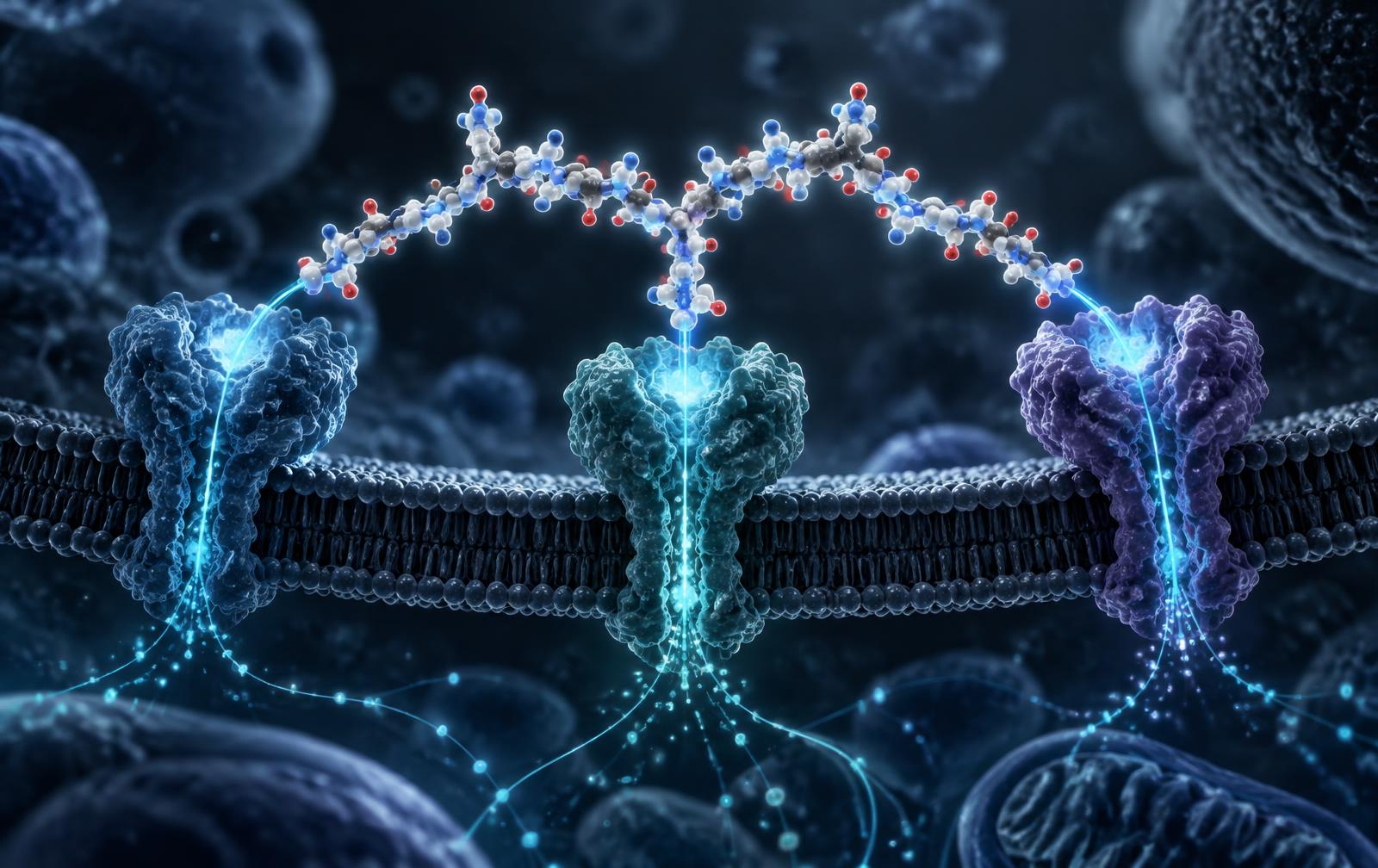
When an appropriate agonist binds to GLP-1R, the receptor changes conformation and activates intracellular signaling pathways.[2]
This concept is central to understanding semaglutide:
- Semaglutide
- ↓
- GLP-1 receptor
- ↓
- intracellular signaling
The molecule itself does not simply “perform” every downstream physiological effect.
Instead, it interacts with a receptor that participates in a larger signaling network.
What Does “Receptor Agonist” Mean?
An agonist is a molecule capable of binding to and activating a receptor.
Natural GLP-1 activates GLP-1R.
Semaglutide was engineered to activate the same receptor while possessing molecular properties that distinguish it from native GLP-1.
This is why semaglutide is described as a GLP-1 receptor agonist rather than simply as GLP-1.
Structural studies have examined semaglutide bound to the GLP-1 receptor and provided molecular-level information about how the peptide engages the receptor and promotes receptor activation.[2]
Semaglutide Is an Engineered Peptide
Semaglutide is structurally related to human GLP-1, but the molecules are not identical.
Researchers modified the peptide to alter properties including its susceptibility to enzymatic degradation and its pharmacokinetic behavior.
One important design strategy involves fatty-acid modification, which promotes association with albumin.
Albumin is an abundant protein circulating in blood.
Association with albumin can influence how a peptide is distributed and cleared, contributing to prolonged exposure compared with native GLP-1.[3]
Semaglutide therefore provides a useful example of peptide engineering:
Start with a naturally occurring biological signaling system, understand how the molecule and receptor interact, and then modify the molecular design to change properties such as stability and duration of action.
From Receptor Binding to Cellular Signaling
What happens after GLP-1R activation?
The GLP-1 receptor is primarily associated with coupling to a G protein known as Gs.
Activation can stimulate adenylyl cyclase, increasing intracellular levels of the signaling molecule cyclic AMP, or cAMP.[2]
That signal can then influence additional intracellular pathways.
A simplified representation is:
- Semaglutide
- ↓
- GLP-1 receptor
- ↓
- Gs protein
- ↓
- Adenylyl cyclase
- ↓
- cAMP
- ↓
- Downstream cellular signaling
Real cellular biology is more complex than this diagram.
GPCR signaling can involve multiple interacting proteins, regulatory mechanisms, receptor trafficking, and different cellular environments.
Modern structural pharmacology continues to investigate these details.[1]
Why Does Receptor Location Matter?
A receptor's effects depend partly on where it is expressed.
GLP-1 receptors are found in tissues involved in metabolic regulation, and research has examined GLP-1R signaling across pancreatic, neural, gastrointestinal, cardiovascular, and other biological systems.[1]
This is why describing semaglutide merely as a molecule that performs one single action oversimplifies its biology.
The same receptor system can participate in multiple physiological processes depending on cellular and tissue context.
Semaglutide and Glucose-Dependent Signaling
One important characteristic of the GLP-1 system is its relationship with glucose-dependent insulin secretion.
GLP-1 receptor activation can enhance insulin secretion when glucose concentrations are elevated.[3]
The term glucose-dependent matters.
It indicates that the biological response is influenced by the surrounding metabolic environment rather than functioning as an unrestricted molecular switch.
GLP-1 signaling also participates in regulation of glucagon secretion and other processes involved in metabolic homeostasis.[3]
These effects helped make GLP-1R an important target for decades of metabolic research.
Semaglutide vs. Retatrutide
Semaglutide and retatrutide both interact with GLP-1R, but they should not be treated as interchangeable molecules.
Their receptor profiles are different.
- Semaglutide:
- GLP-1R agonist
- Retatrutide:
- GIPR + GLP-1R + GCGR agonist
Semaglutide therefore provides an example of single-receptor agonism, while retatrutide is being investigated as a triple-receptor agonist.
This comparison demonstrates an important trend in peptide pharmacology.
Researchers can study both highly targeted receptor activation and engineered molecules designed to engage multiple signaling systems.
From Research Molecule to Approved Medicine
Unlike retatrutide, semaglutide is not investigational as a molecule overall.
It has undergone extensive clinical development and has received FDA approval in multiple formulations and indications.
FDA records show that semaglutide first received U.S. approval as Ozempic in December 2017 for adults with type 2 diabetes.
Oral semaglutide was subsequently approved as Rybelsus in September 2019.
Semaglutide is also marketed as Wegovy under separate FDA-approved labeling.[4]
The exact approved uses differ among products and can change as additional evidence is reviewed.
That distinction is important:
Semaglutide is the active molecule.
Individual FDA-approved products have specific formulations, labeling, and approved indications.
Scientific discussion of the molecule should not blur those separate concepts.
Clinical Evidence and Molecular Mechanism Are Different Questions
Clinical research can establish whether an intervention produces particular outcomes in defined study populations.
Mechanistic research asks different questions:
- Which receptor does the molecule bind?
- How does the receptor change when activated?
- Which intracellular pathways respond?
- Which tissues participate?
- How do structural modifications change pharmacological behavior?
Both kinds of evidence matter, but they should not be confused.
For example, structural studies can show how semaglutide engages GLP-1R.[2]
Clinical trials can investigate outcomes associated with semaglutide-containing medicines.
Neither type of evidence replaces the other.
Together, they build a more complete picture of the molecule.
What Scientists Are Still Investigating
Semaglutide has been studied extensively, but that does not mean every aspect of its biology is completely understood.
Current research continues to investigate topics such as:
- Detailed GLP-1R signaling behavior
- Receptor conformational dynamics
- Differences in signaling across tissues
- Interactions among metabolic pathways
- Long-term biological responses
- Why individuals can respond differently
- How GLP-1R signaling interacts with broader molecular networks
A 2025 review of GLP-1R structural pharmacology highlighted continuing research into receptor dynamics, downstream signaling, and differences among GLP-1R agonists.[1]
Some proposed broader molecular mechanisms remain based substantially on preclinical evidence and should not automatically be assumed to occur identically in humans.[5]
That distinction between established evidence and emerging hypotheses is an important part of scientific interpretation.
Why Semaglutide Matters Scientifically
Semaglutide is useful for understanding more than one particular molecule.
It illustrates several major ideas in modern biotechnology:
- Peptide engineering
- Receptor pharmacology
- GPCR signaling
- Structure-function relationships
- Pharmacokinetic modification
- Translation from molecular research to clinical development
Its development demonstrates how scientists can begin with a naturally occurring signaling pathway and engineer a molecule with altered pharmacological characteristics while preserving activity at a specific receptor.
That makes semaglutide a useful case study in modern peptide science.
The Takeaway
Semaglutide is a peptide-based GLP-1 receptor agonist.
Its defining molecular target is:
- GLP-1R
Binding and activation of this receptor initiate intracellular signaling involved in metabolic regulation.
Semaglutide's molecular structure was engineered to provide pharmacological properties different from native GLP-1, including prolonged exposure.
Unlike the investigational triple agonist retatrutide, semaglutide targets GLP-1R rather than combining agonism across GIPR, GLP-1R, and GCGR.
And unlike retatrutide, semaglutide is already present in multiple FDA-approved medicines.
Understanding semaglutide therefore begins with something deeper than its familiar name:
a modified peptide, a specific receptor, and the cellular signaling that connects them.
Reference
Key Terms
- Semaglutide
- A peptide-based glucagon-like peptide-1 receptor agonist used as the active molecule in multiple FDA-approved medicines.
- GLP-1
- Glucagon-like peptide-1, a naturally occurring peptide hormone involved in nutrient-responsive and metabolic signaling.
- GLP-1R
- The glucagon-like peptide-1 receptor, a G protein-coupled receptor activated by GLP-1 and GLP-1 receptor agonists.
- Agonist
- A molecule that binds to and activates a receptor.
- GPCR
- G protein-coupled receptor, a large family of cell-surface receptors that transmit extracellular signals into cells.
- Gs Protein
- A signaling G protein associated with activation of adenylyl cyclase.
- cAMP
- Cyclic adenosine monophosphate, an intracellular signaling molecule involved in many cellular pathways.
- Adenylyl Cyclase
- An enzyme involved in producing cAMP from ATP following activation of certain signaling pathways.
- Albumin
- An abundant circulating protein. Molecular association with albumin can influence the pharmacokinetic behavior of some engineered peptides.
- Peptide Engineering
- The modification or design of peptide molecules to alter properties such as stability, receptor activity, or pharmacokinetic behavior.
References
- [1] Zhou Q, Zhao F, Zhang Y, Yang D, Wang M-W. Structural pharmacology and mechanisms of GLP-1R signaling. Trends in Pharmacological Sciences. 2025;46(5):422–436.
- [2] Zhao P, Liang Y-L, Belousoff MJ, et al. Structure and dynamics of semaglutide- and taspoglutide-bound GLP-1R-Gs complexes. Cell Reports. 2021;36(2):109374.
- [3] Kalra S, Sahay R. A Review on Semaglutide: An Oral Glucagon-Like Peptide 1 Receptor Agonist in Management of Type 2 Diabetes Mellitus. Diabetes Therapy. 2020;11:1965–1982.
- [4] U.S. Food and Drug Administration. FDA-Approved GLP-1 Receptor Agonists.
- [5] Papakonstantinou I, Tsioufis K, Katsi V. Spotlight on the Mechanism of Action of Semaglutide. Current Issues in Molecular Biology. 2024;46(12):14514–14541.
This article is for educational and informational purposes only. It does not provide medical advice, diagnosis, or treatment recommendations.
Back to the journalContinue Reading
Related Stories
Peptide Decoded
What Is Retatrutide? | Peptide Decoded #01
Retatrutide is an investigational triple receptor agonist targeting GIP, GLP-1, and glucagon receptors. Explore how its molecular design works and where the clinical research stands in 2026.
By The Vault Journal Editorial Team · 7–9 min read

Molecular Biology
Peptides vs. Proteins: What's the Difference?
Peptides and proteins are both built from amino acids, but they aren't interchangeable terms. Learn how chain length, sequence, folding, structure, and biological context distinguish them.
By The Vault Journal Editorial Team · 6–8 min read

Lab Science
What Is HPLC? Understanding High-Performance Liquid Chromatography
HPLC separates components within a liquid sample so researchers can examine them individually. Learn how the technique works, what a chromatogram shows, and why understanding the analytical method matters.
By The Vault Journal Editorial Team · 6–8 min read