A Before-and-After Can Show Change. Can It Tell Us What Caused It?
A real transformation provides a striking visual. But when tesamorelin is part of the story, separating observation from causation requires looking beyond the photograph.
By The Vault Journal Editorial Team · Published September 20, 2026 · 7–9 min read
Published by The Vault Journal — A Bio Vault Labs Publication
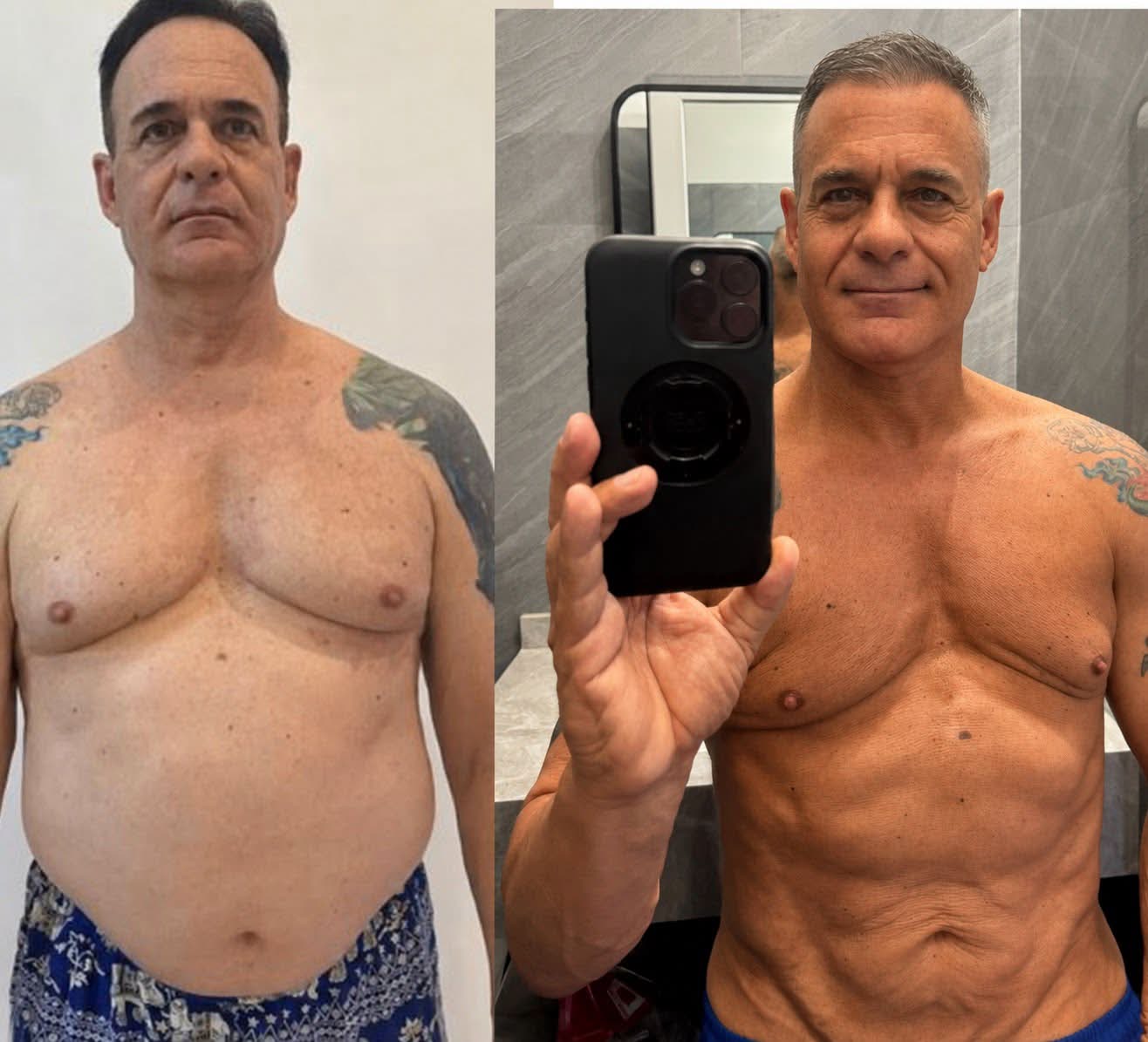
Two photographs. Two moments in time. The difference is immediately visible.
But a more difficult question follows: what caused it?
That question is not rhetorical, and it is not easily answered by looking harder at the images. A photograph is a record of appearance at a moment. It documents an observation. It does not, on its own, contain the information needed to explain why the appearance changed.
The individual pictured here has given permission for these photographs to be published. Tesamorelin, a peptide we will examine in detail below, was reported as one part of his experience. That report is an anecdote — an interesting observation offered in good faith. It is not evidence that tesamorelin produced this outcome, and it is not a prediction about what would happen to anyone else.
The distance between those two statements — *this changed* and *this caused that change* — is where science actually happens. This guide is about learning to see that distance clearly.
What a Before-and-After Actually Shows
Begin with what can be legitimately observed. Two photographs of the same person, taken at different times, can document that visible characteristics differ between those two moments: outline, apparent body composition, posture, skin tone, hair.
That is a real finding, and it should not be dismissed. Visible change is data.
What the photographs cannot document is the interval between them. Everything that happened in that gap — every meal, every night of sleep, every training session, every health event, every measurement never taken — is absent from the frame. And it is precisely that interval that contains the explanation.
Consider how many variables can differ between two images of the same person:
- Elapsed time — Weeks, months, or years of accumulated change compressed into a single comparison.
- Nutrition — Total energy intake, food composition, and consistency of eating patterns.
- Physical activity — Resistance training, cardiovascular exercise, daily movement, and progression over time.
- Sleep and recovery — Duration and quality, both of which interact with appetite, training capacity, and hormonal regulation.
- Health circumstances — Illness, injury, medication changes, and existing medical conditions.
- Individual biology — Age, genetics, endocrine status, and baseline body composition.
- Photographic conditions — Lighting, camera angle, distance, lens characteristics, posture, time of day, hydration status, and whether the subject is relaxed or braced.
The final item deserves emphasis, because it is the one most often overlooked. Two photographs taken minutes apart under different lighting and posture can look meaningfully different without any underlying physiological change at all. That does not mean any given comparison is misleading — it means photography alone cannot distinguish real change from presentation.
We are not going to speculate about which of these factors produced the transformation shown above. That is the entire point. We do not know, and neither does the photograph.
Where Tesamorelin Enters the Story
Tesamorelin was reported as one component of this individual's experience during the period between the two photographs.
Notice the careful phrasing. *Reported as one component.* Not identified as the cause, not isolated as a variable, not measured against a comparison group.
This is the structure of anecdotal evidence: a person observes an outcome, identifies something that was present during the same period, and reasonably wonders whether the two are connected. Wondering is legitimate. It is often how research questions begin.
But personal experience and controlled scientific evidence answer different questions. Personal experience answers *what happened to me?* Controlled research answers *what happens, on average, to people like those we studied, compared with people who did not receive the intervention?*
Only the second question can support a causal claim, because only the second design allows the intervention to be separated from everything else that was happening at the same time.
What follows is an examination of what tesamorelin is, what it is authorized to treat, and what controlled research has actually measured. None of it is guidance for use, and none of it should be read as a recommendation.
What Is Tesamorelin?
Tesamorelin is a synthetic analog of growth hormone-releasing hormone (GHRH) — the same molecule that FDA labeling also refers to as growth hormone-releasing factor, or GHRF.[1]
GHRH is a peptide produced in the hypothalamus. Its role is regulatory rather than direct: it acts on somatotroph cells in the pituitary gland to stimulate the synthesis and pulsatile release of the body's own growth hormone (GH).[1] In laboratory studies, tesamorelin binds and stimulates human GHRH receptors with potency similar to the endogenous hormone.[1]
That mechanism matters for understanding what kind of molecule this is. Tesamorelin is not growth hormone. It is an upstream signal that acts on the pathway responsible for releasing growth hormone, which is why molecules of this class are sometimes described as secretagogues — substances that prompt secretion rather than replacing the secreted product.
Growth hormone then acts on receptors across many tissues, including chondrocytes, osteoblasts, myocytes, hepatocytes, and adipocytes, producing a range of downstream effects.[1] Some — but not all — of those effects are mediated primarily by insulin-like growth factor 1 (IGF-1) produced in the liver and peripheral tissues.[1]
Pharmacologically, this produces a measurable cascade: tesamorelin stimulates growth hormone secretion, and subsequently increases IGF-1 and IGFBP-3 levels.[1] FDA labeling identifies elevated IGF-1 as a specific clinical consideration, noting that the effects of prolonged elevation are unknown and that IGF-1 levels are monitored during therapy.[1]
In other words, this is a molecule that acts on a signaling axis with system-wide reach. That is a scientific description, not an endorsement.
What Tesamorelin Is Actually Approved For
This section requires precision, because it is the one most frequently misstated.
Tesamorelin is approved in the United States under the brand names EGRIFTA WR and EGRIFTA SV, with an initial U.S. approval date of 2010. The FDA-approved indication is narrow and specific: it is indicated for the reduction of excess abdominal fat in HIV-infected adult patients with lipodystrophy.[1]
That is the entire authorized population. Adults with HIV who have lipodystrophy — a condition involving abnormal distribution of body fat, which in this population has been associated with antiretroviral therapy.
The label then states its limitations of use directly. Among them:
- Tesamorelin is not indicated for weight loss management, as it has a weight neutral effect.[1]
- Long-term cardiovascular safety has not been established.[1]
- There are no data supporting improved compliance with antiretroviral therapies in patients taking it.[1]
The phrase *weight neutral effect* is worth sitting with. It is not a hedge or a legal formality — it reflects what the clinical data showed about body weight as an outcome.
This has a direct consequence for how the photograph above should be read: tesamorelin's regulatory approval does not explain, validate, or account for the transformation pictured. The approved indication describes a different outcome, in a different population, for a different clinical purpose. Citing an approval as though it certifies an unrelated result is a category error, however common it has become.
What Clinical Research Can Actually Tell Us
The clinical program behind tesamorelin's approval consisted of randomized, double-blind, placebo-controlled trials conducted in adults with HIV and excess abdominal fat.
The initial trial published in *The New England Journal of Medicine* in 2007 assessed whether a GHRH analog could decrease visceral adiposity in patients with HIV, in whom visceral adipose tissue accumulation during antiretroviral therapy has been associated with increased cardiovascular risk.[2] A second randomized placebo-controlled trial with a safety extension followed in 2010,[3] and a pooled analysis of two multicenter, double-blind, placebo-controlled phase 3 trials with safety extension data was published the same year.[4]
Later research examined a different question in an overlapping population: a randomized, double-blind, multicenter trial published in *The Lancet HIV* in 2019 evaluated effects on non-alcoholic fatty liver disease in people with HIV.[5]
Two features of this body of work are essential to reading it honestly. First, the studied population was consistently adults with HIV — not the general public, not healthy adults seeking body composition change. Second, the primary outcomes were specific measured endpoints, not overall appearance.
Visceral fat, body composition, and body weight are not the same measurement
These three terms are routinely collapsed together in popular discussion, and the distinction is where most misreading occurs.
- Visceral adipose tissue (VAT) is fat located within the abdominal cavity, surrounding internal organs. It is quantified with imaging, and it was the outcome the tesamorelin trials were designed to measure.[2]
- Body composition describes the proportions of tissue types — fat mass, lean mass, bone, water. A change in composition can occur with no change in total weight at all.
- Body weight is the number on a scale. It aggregates everything, and it is the measure FDA labeling describes tesamorelin as leaving essentially unchanged.[1]
A molecule can reduce a specific fat depot in a specific population while being weight neutral overall. Those findings are not contradictory. They are simply answers to different questions — which is exactly why generalizing them beyond the populations and outcomes actually studied is not permissible, however intuitive the leap may feel.
Nothing in this research constitutes a treatment recommendation, and nothing in it addresses whether the transformation photographed above is attributable to tesamorelin.
Why One Transformation Isn't a Clinical Trial
The individual in the photograph accomplished something real. Nothing in this analysis diminishes that, and nothing here suggests he has misrepresented his experience.
The limitation is structural, not personal. A single case, however well documented, cannot do what a trial does — because a trial is deliberately built to rule out the alternative explanations a single case cannot exclude.
Here is what that machinery is for:
- Control groups — A comparison group that does not receive the intervention establishes what would have happened anyway. Without one, ordinary change over time is indistinguishable from an effect.
- Randomization — Assigning participants by chance prevents the more motivated, healthier, or more responsive people from clustering in one group and manufacturing a difference that has nothing to do with the intervention.
- Larger sample sizes — Individual results vary enormously. Studying many people distinguishes a consistent signal from a striking outlier.
- Standardized measurements — Imaging and laboratory assays quantify defined tissues and analytes. Photographs cannot, because lighting and posture are not standardized variables.
- Predefined outcomes — Declaring in advance what will be measured prevents researchers from searching afterward for whichever result happens to look best.
- Statistical analysis — Formal analysis estimates how likely an observed difference is to reflect something real rather than chance.
Confounding variables are the reason all of this exists. A confounder is a factor that travels alongside the thing you are studying and could independently produce the outcome. In a single transformation, potential confounders are not merely present — they are unmeasured and unmeasurable after the fact.
Individual biological variation compounds the problem. Two people following identical routines can produce different outcomes for reasons involving age, genetics, endocrine status, and baseline physiology. This is why one person's result — good or disappointing — cannot forecast another's.
The photograph, then, is an excellent teaching example precisely because it is genuine. It shows real change. It simply cannot show why.
Personal Experience vs. Scientific Evidence
None of this makes personal experience worthless. Anecdotes serve a real function in science: they generate hypotheses. Clinicians noticing unexpected patterns in individual patients have opened entire fields of investigation.
The distinction is one of role. Anecdotal evidence is uncontrolled observation — a single instance, unrandomized, without a comparison group, with outcomes assessed informally and often reported only when the result was notable. Controlled research is designed comparison — prespecified, randomized where possible, measured with standardized instruments, and reported whether or not the result was favorable.
There is also a visibility problem that is easy to miss. Transformations that appear striking are shared; unremarkable outcomes usually are not. What reaches an audience is therefore a filtered sample, not a representative one. This is why compelling individual stories can accumulate around interventions that controlled trials later fail to support.
An anecdote can make a question worth asking. It cannot answer it.
How to Read Transformation Claims More Critically
None of this requires scientific training. It requires a short sequence of questions, applied consistently to any before-and-after you encounter — including this one.
- What can I actually observe? Separate the documented observation from the narrative attached to it.
- What explanation is being proposed? Identify the specific causal claim, including one that is merely implied by placement or juxtaposition.
- What other variables could have changed? List the plausible alternatives — time, nutrition, training, sleep, health circumstances, photographic conditions.
- Is there controlled evidence? Look for randomized comparison against a control group, not testimonials or case collections.
- Who was actually studied? Check whether the trial population resembles the person the claim is being applied to.
- What outcome did researchers actually measure? A trial measuring a specific fat depot has not measured overall appearance or body weight.
- Does the evidence demonstrate causation, or merely an association? Two things occurring together is the beginning of an investigation, not its conclusion.
This framework is about evaluating evidence. It is not a guide to using tesamorelin or any other medication, and no part of this article should be read that way. Decisions about medical treatment belong with qualified healthcare professionals working from a complete clinical picture.
Seeing Change, Explaining Change
Return to the two photographs at the top of this page.
They show something. That much is not in dispute. What they cannot show is the interval between them — the accumulated decisions, the biology, the circumstances, the variables no one recorded because no one was conducting a study.
Tesamorelin has a defined mechanism as a GHRH analog acting on growth hormone signaling and downstream IGF-1 physiology.[1] It has a narrow FDA-approved indication in adults with HIV and lipodystrophy, and labeling that explicitly states it is not indicated for weight loss management.[1] It has a body of randomized controlled research conducted in that population, measuring specific endpoints.[2][3][4][5] Those are the things that are actually known.
The photograph is real. The transformation is real. But understanding *why* change occurred requires more than a photograph. That is where scientific evidence begins.
Reference
Key Terms
- Observation
- A documented record of what was seen or measured. A before-and-after photograph is an observation about appearance at two moments in time.
- Correlation
- A statistical relationship in which two things vary together. Correlation establishes that an association exists, not that one thing produced the other.
- Causation
- A relationship in which one factor actually produces a change in another. Establishing causation generally requires controlled comparison rather than observation alone.
- Confounding variable
- A factor present alongside the intervention being studied that could independently produce the observed outcome, making the intervention's contribution impossible to isolate.
- GHRH (growth hormone-releasing hormone)
- A hypothalamic peptide, also referred to in FDA labeling as growth hormone-releasing factor, that acts on pituitary somatotroph cells to stimulate synthesis and pulsatile release of growth hormone.
- IGF-1 (insulin-like growth factor 1)
- A growth factor produced in the liver and peripheral tissues that mediates some, but not all, of the downstream effects of growth hormone.
- Visceral adipose tissue (VAT)
- Fat located within the abdominal cavity around internal organs, quantified by imaging. Distinct from total body weight and from overall body composition.
- Anecdotal evidence
- Uncontrolled observation from individual experience. Useful for generating research questions; generally unable to establish causation on its own.
References
- [1] U.S. Food and Drug Administration / DailyMed EGRIFTA WR (tesamorelin) for injection — Full Prescribing Information
- [2] Falutz J, et al. N Engl J Med. 2007;357(23):2359–2370 Metabolic effects of a growth hormone-releasing factor in patients with HIV
- [3] Falutz J, et al. J Acquir Immune Defic Syndr. 2010;53(3):311–322 Effects of tesamorelin, a growth hormone-releasing factor, in HIV-infected patients with abdominal fat accumulation: a randomized placebo-controlled trial with a safety extension
- [4] Falutz J, et al. J Clin Endocrinol Metab. 2010;95(9):4291–4304 Effects of tesamorelin (TH9507), a growth hormone-releasing factor analog, in HIV-infected patients with excess abdominal fat: a pooled analysis of two multicenter, double-blind placebo-controlled phase 3 trials with safety extension data
- [5] Stanley TL, et al. Lancet HIV. 2019;6(12):e821–e830 Effects of tesamorelin on non-alcoholic fatty liver disease in HIV: a randomised, double-blind, multicentre trial
- [6] DailyMed EGRIFTA SV (tesamorelin) for injection — Full Prescribing Information
This article is for educational and informational purposes only. It does not provide medical advice, diagnosis, or treatment recommendations.
Back to the journalContinue Reading
Related Stories

Molecular Biology
Peptides vs. Proteins: What's the Difference?
Peptides and proteins are both built from amino acids, but they aren't interchangeable terms. Learn how chain length, sequence, folding, structure, and biological context distinguish them.
By The Vault Journal Editorial Team · 6–8 min read

Peptide Decoded
What Is Semaglutide? | Peptide Decoded #02
Semaglutide is a peptide-based GLP-1 receptor agonist. Explore how it interacts with GLP-1R, how receptor activation produces cellular signaling, and how peptide engineering changed its pharmacological properties.
By The Vault Journal Editorial Team · 7–9 min read

Lab Science
How to Read a Certificate of Analysis
A Certificate of Analysis contains more than a headline percentage. Learn how to evaluate batch information, analytical methods, specifications, results, reference standards, and traceability.
By The Vault Journal Editorial Team · 7–9 min read