Why Receptor Activation Doesn’t Tell Us the Whole Story
A molecule can interact with a receptor without automatically telling us what the final biological outcome will be. Between receptor activation and a measurable response lies an entire chain of biological signaling.
By The Vault Journal Editorial Team · Published September 14, 2026 · 6–8 min read
Published by The Vault Journal — A Bio Vault Labs Publication
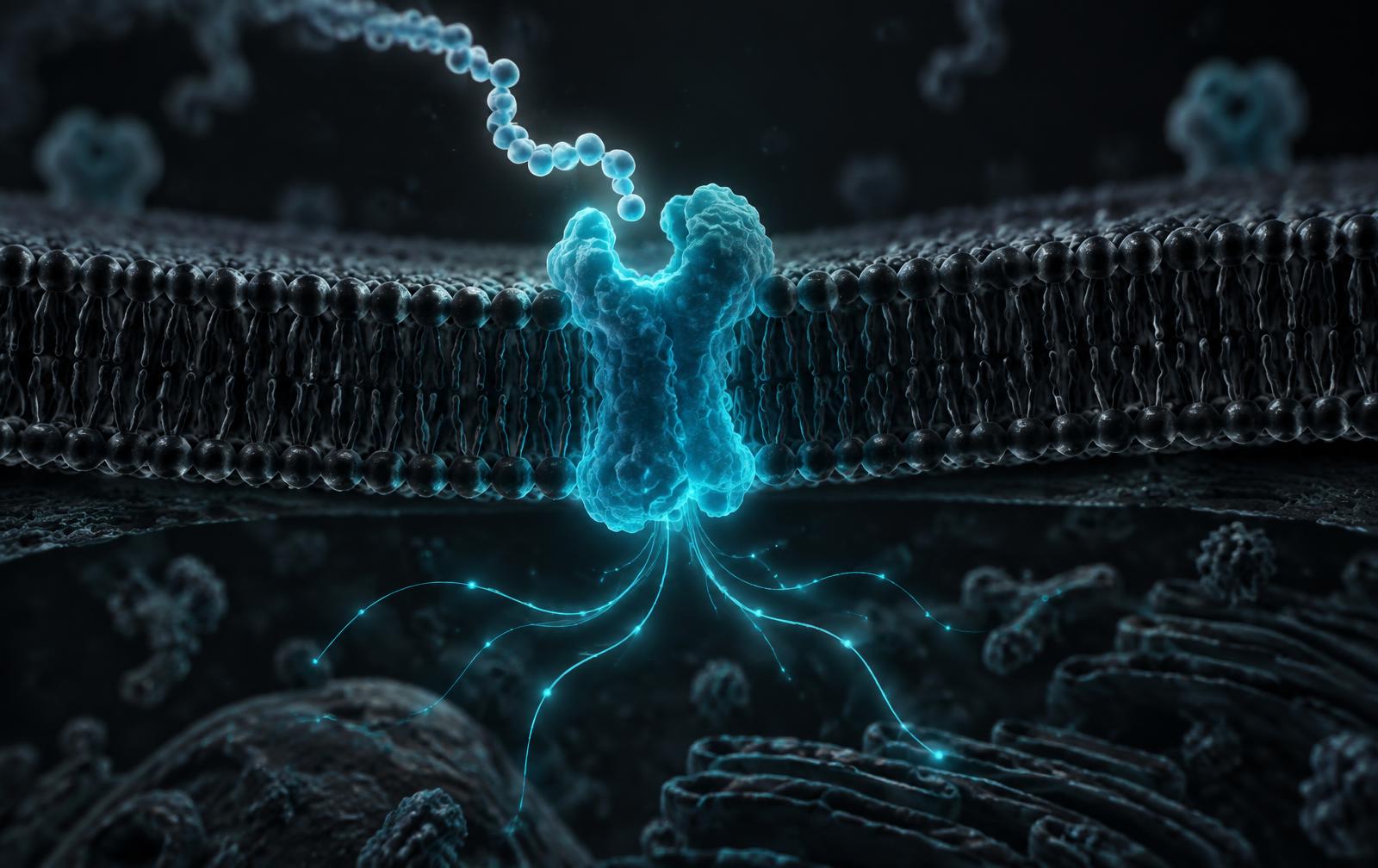
There is a shortcut that appears constantly in discussions of peptide science, and it sounds reasonable enough: “this molecule activates that receptor, so we know what it does.”
The first half of that sentence can be a well-established laboratory finding. The second half is a much larger claim — and it does not follow automatically.
Receptor activation is a starting event. What happens after it depends on signaling machinery inside the cell, on which cells carry the receptor at all, on the tissue those cells sit in, and on the biological context of the whole organism at that moment. Knowing that a key fits a lock does not tell you what is behind the door.
This is not a technicality. It is one of the main reasons a molecule with a clean, well-characterized mechanism can still behave unpredictably when it is actually measured in a living system.
Peptide Decoded — Watch
Bio Vault Labs 🧬 · Peptide Decoded
The Mechanism Is Only the Beginning
A quick visual explanation of why receptor activation is only one step in understanding a biological response.
Read: Peptides vs. Proteins — What’s the Difference?What a Receptor Actually Is
A receptor is a protein that recognizes a specific signal and converts that recognition into a change inside the cell.[1]
Some receptors sit in the cell membrane with part of the protein facing outward, where circulating signals can reach them. Others sit inside the cell. Peptide signals generally act at membrane receptors, because peptides do not readily cross the cell membrane on their own.[1]
A large share of the receptors relevant to peptide signaling belong to one family: G protein-coupled receptors, or GPCRs. These receptors pass through the membrane, and when the outside portion binds its signal, the shape of the protein changes in a way that the inside of the cell can detect.[2]
That shape change is the entire point. A receptor is not a switch that releases a substance. It is a translator — it converts an event outside the cell into activity inside it.
What “Activation” Means — and What It Doesn’t
In pharmacology, a molecule that binds a receptor and produces a response is called an agonist. One that binds without producing that response, and blocks the receptor in the process, is an antagonist.[3]
But even within “agonist” there is more detail than the word suggests. Pharmacologists distinguish between two separate properties:
- Affinity — how readily a molecule binds the receptor.
- Efficacy — how much of a response that binding actually produces once it happens.[3]
A molecule can bind a receptor tightly and still produce only a partial response. Two molecules can bind the same receptor and preferentially engage different downstream signaling routes, a phenomenon studied under the heading of biased or pathway-selective signaling.[4]
So “it activates the receptor” is genuinely useful information. It just does not specify which signals were produced, how strongly, for how long, or in which cells.
The Chain Between Mechanism and Outcome
It helps to lay out the sequence explicitly. Every step below is a place where the biology can diverge from the prediction.
Molecule
Receptor
Downstream signaling
Cellular response
Tissue / system response
Measurable outcome
Downstream Signaling: What Happens Inside
When a GPCR changes shape, it activates partner proteins inside the cell, which in turn alter the levels of small intracellular messengers. Those messengers activate enzymes, which modify other proteins, which change what the cell is doing — including which genes it transcribes.[1,2]
Two features of this cascade matter for our question.
First, it amplifies. A small number of binding events can produce a much larger internal change, which is why signal strength at the receptor does not map neatly onto response size.[1]
Second, it branches and regulates itself. Cells desensitize receptors, remove them from the surface, and run feedback loops that dampen or extend a signal. A response is shaped by the cell's own regulatory state as much as by the incoming signal.[1]
Why the Same Signal Produces Different Results
This is the step most often skipped. The same receptor, activated by the same molecule, can produce different outcomes in different cells — because the response is assembled from whatever signaling components that particular cell contains.[1]
Several factors sit behind that:
- Receptor distribution. A receptor is rarely confined to one tissue. Where it is expressed determines which parts of the body can respond at all.[2]
- Cell type. Two cells with the same receptor may hold different downstream proteins, and therefore reach different endpoints from the same starting event.[1]
- Receptor density and availability. How many receptors are present, and whether they are on the surface or internalized, changes the response.[1]
- Signal timing. Brief and sustained signals are not interchangeable; cells frequently interpret duration and pattern, not just presence.[1]
- Biological context. Other active signaling systems, metabolic state, and physiological conditions all shape how a cell responds.[1]
None of this makes mechanism unknowable. It means mechanism describes a capability, and the biology determines the result.
Mechanism and Outcome Are Different Levels of Evidence
Two statements often get compressed into one, and separating them is the single most useful habit in reading peptide science:
“Scientists understand a plausible biological mechanism”
This means a molecular pathway has been identified and characterized — typically in cells, in isolated tissue, or in structural and biochemical work. It is real knowledge, and it is often what makes a molecule worth studying at all. What it establishes is that an effect is biologically plausible.
“Scientists have demonstrated a particular real-world outcome”
This means a defined outcome was measured, in a defined population, under defined conditions, with a comparison group that makes the result interpretable. It answers a different question: not *could this happen*, but *did it, in whom, and how reliably*.
Neither statement is the weaker version of the other. They describe different links in the chain. A well-understood mechanism does not guarantee an outcome, and a measured outcome does not automatically confirm the mechanism proposed to explain it — a distinction we examined from the opposite direction in A Before-and-After Can Show Change. Can It Tell Us What Caused It?.
How Researchers Investigate Different Parts of the Chain
Because the chain has several links, no single study design covers all of it. Research is layered deliberately.
- Cell and biochemical studies examine binding, receptor activation, and downstream signaling in controlled conditions — the upper links.[2]
- Preclinical animal research looks at how a molecule behaves in an intact organism: distribution, stability, and tissue-level effects.[5]
- Human clinical research measures outcomes in people, in phases designed to answer progressively broader questions.[6]
Each layer answers what the one below it cannot. Cell work can characterize a pathway with precision but cannot tell you what happens across a whole organism. Animal work adds physiology but not human physiology. Only human studies measure human outcomes — which is why translational research programs are organized as a sequence rather than a single experiment.[7]
This layering is also why the phrase “research chemical” carries real meaning. For many molecules, the upper links of the chain have been studied and the lower ones have not.
Reading Claims With the Chain in Mind
Once the sequence is visible, a useful question follows almost any claim about a molecule: which link is this statement about?
“It binds receptor X” is a claim about link two. “It produces outcome Y” is a claim about link six. They require different evidence, and a citation supporting one does not support the other.
The same logic applies to the vocabulary. Calling something a peptide describes its chemistry, not its function — the category alone predicts nothing, as Peptides vs. Proteins: What’s the Difference? sets out. Naming a receptor identifies a starting point, not a destination.
The Takeaway
Receptor activation is a real, measurable, important event. It is also the first step in a sequence that includes intracellular signaling, cell-specific responses, tissue-level coordination, and finally something that can actually be measured in an organism.
Understanding the mechanism tells us what is plausible. Only measurement tells us what happened. Keeping those two statements separate is not scientific pedantry — it is most of what separates a careful reading of the evidence from a confident one.
Reference
Key Terms
- Receptor
- A protein that recognizes a specific signal and converts that recognition into a change inside the cell.
- Agonist
- A molecule that binds a receptor and produces a response at it.
- Antagonist
- A molecule that binds a receptor without producing that response, blocking it in the process.
- Affinity
- How readily a molecule binds to a receptor.
- Efficacy
- How much response that binding produces once it occurs — a property separate from affinity.
- GPCR
- G protein-coupled receptor: a large family of membrane receptors that transmit signals to partner proteins inside the cell.
- Downstream signaling
- The chain of intracellular events that follows receptor activation and shapes the cellular response.
- Receptor distribution
- Which cells and tissues express a given receptor, determining where a signal can act at all.
- Biased signaling
- When different molecules acting at the same receptor preferentially engage different downstream pathways.
References
- [1] Alberts B, Johnson A, Lewis J, et al. General Principles of Cell Communication. In: Molecular Biology of the Cell. 4th ed. New York: Garland Science; 2002. NCBI Bookshelf.
- [2] Alberts B, Johnson A, Lewis J, et al. Signaling through G-Protein-Linked Cell-Surface Receptors. In: Molecular Biology of the Cell. 4th ed. New York: Garland Science; 2002. NCBI Bookshelf.
- [3] Neubig RR, Spedding M, Kenakin T, Christopoulos A. International Union of Pharmacology Committee on Receptor Nomenclature and Drug Classification. XXXVIII. Update on Terms and Symbols in Quantitative Pharmacology. Pharmacological Reviews. 2003;55(4):597–606. PMID 14657418.
- [4] Hauser AS, Attwood MM, Rask-Andersen M, Schiöth HB, Gloriam DE. Trends in GPCR Drug Discovery: New Agents, Targets and Indications. Nature Reviews Drug Discovery. 2017;16(12):829–842. PMID 29075003.
- [5] U.S. Food and Drug Administration. Step 2: Preclinical Research — The Drug Development Process.
- [6] U.S. Food and Drug Administration. Step 3: Clinical Research — The Drug Development Process.
- [7] National Center for Advancing Translational Sciences (NIH). About Translational Science.
- [8] IUPHAR/BPS Guide to Pharmacology. Pharmacology Education — receptor and ligand terminology resources.
This article is for educational and informational purposes only. It does not provide medical advice, diagnosis, or treatment recommendations.
Back to the journalContinue Reading
Related Stories
Molecular Biology
Peptides vs. Proteins: What's the Difference?
Peptides and proteins are both built from amino acids, but they aren't interchangeable terms. Learn how chain length, sequence, folding, structure, and biological context distinguish them.
By The Vault Journal Editorial Team · 6–8 min read
Peptide Decoded
What Is Retatrutide? | Peptide Decoded #01
Retatrutide is an investigational triple receptor agonist targeting GIP, GLP-1, and glucagon receptors. Explore how its molecular design works and where the clinical research stands in 2026.
By The Vault Journal Editorial Team · 7–9 min read
Peptide Decoded
What Is Semaglutide? | Peptide Decoded #02
Semaglutide is a peptide-based GLP-1 receptor agonist. Explore how it interacts with GLP-1R, how receptor activation produces cellular signaling, and how peptide engineering changed its pharmacological properties.
By The Vault Journal Editorial Team · 7–9 min read